
Key Takeaways
A convergence of forces is driving increased market volatility and more frequent dislocations, reinforcing the need for flexible capital that can move quickly and at scale. Opportunistic investing strategies allow capital to be deployed across varying asset classes, capital structures, and liquidity profiles to rapidly capitalize on opportunities that fall outside traditional investment mandates.
Forces Reshaping the Opportunity Set
Markets remain volatile, with equity dispersion near decade highs and market leadership concentrated among a narrow set of top performers. Macro shocks remain capable of triggering rapid, correlated selloffs across asset classes.
On top of this volatility, higher interest rates have raised borrowing costs, leaving companies that relied on inexpensive financing to navigate refinancing challenges and more complex capital structures — a dynamic set to intensify as a wave of lower-rated corporate debt approaches maturity over the next few years. At the same time, private market transaction activity has slowed from earlier-cycle highs, prompting sponsors to explore alternative capital sources for portfolio companies, acquisitions, and transitional situations.
These conditions can also introduce pricing inefficiencies: when liquidity turns selective, assets may trade at prices that differ from perceived long-term value — creating openings for investors who can provide flexible capital.
“In periods of market volatility and uncertainty, investors with flexible mandates are best positioned to move quickly on opportunities that fall outside conventional allocation.”

Capturing Opportunity Through Flexible Deployment Across Asset Classes
Since 2016, GCM Grosvenor’s opportunistic strategies have shifted allocations meaningfully year to year across private equity subclasses, credit opportunities, real assets, and special situations to reflect where we see the most compelling risk-adjusted returns. This flexibility to move capital toward the areas of greatest opportunity at any given point in the cycle, rather than anchoring to a static mix, is core to how we have navigated changing conditions over the past decade.
This flexibility is reinforced by the breadth of GCM Grosvenor’s relationships across the alternatives ecosystem, providing earlier visibility, deeper market insight, and access to a wider range of transaction types. Our open-architecture platform includes relationships with hundreds of managers across private equity, credit, real assets, and hedge fund strategies, delivering differentiated sourcing, cross-market perspective, and insight into evolving conditions across asset classes and capital structures.
OPPORTUNISTIC STRATEGY INVESTMENT ALLOCATION ACROSS ASSET TYPES
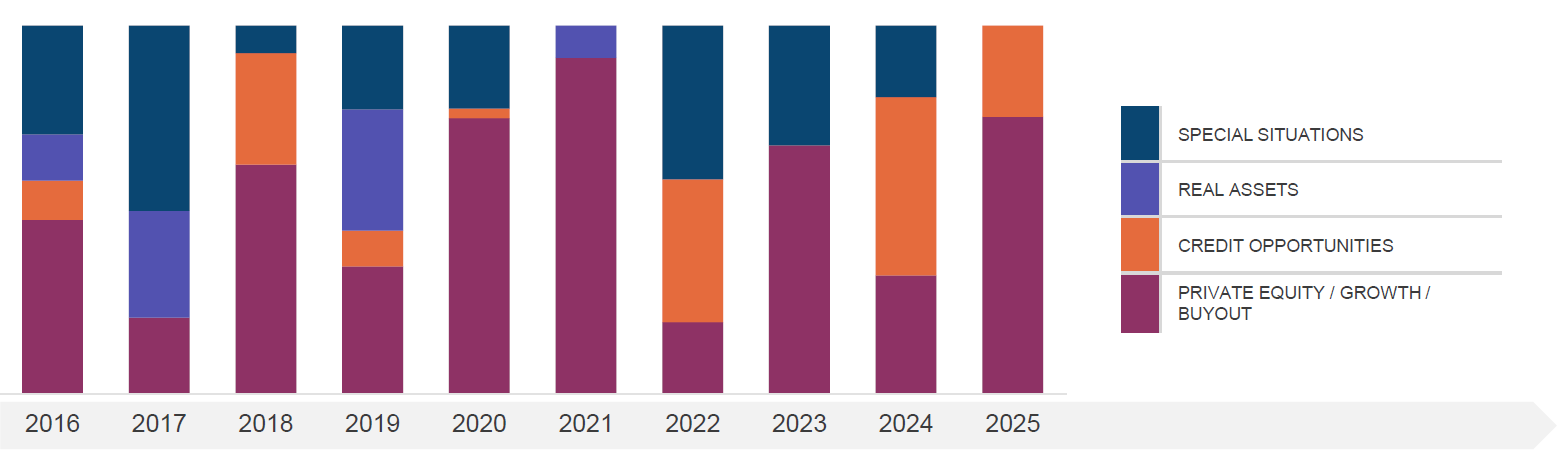
SOURCE: GCM Grosvenor. (2025). Opportunistic strategy allocation data, 2016–2025..
Illustrative annual presentation of asset class allocation of investments across multiple GCM Grosvenor opportunistic strategies..
GCM Grosvenor’s Open-Architecture Sourcing Network
Relationships with 825+ investment managers across private equity, credit, real assets, and hedge fund strategies.¹
1000+ deals a year across co-investments and direct investments.
Market visibility informed by activity across public and private markets, capital structures, and liquidity profiles.
Cross-platform insights that may support evaluation of dislocated, transitional, and special situation investments.
Execution Capabilities Can Influence Opportunity Access
Opportunistic situations often emerge quickly and require complex transactions to be evaluated on compressed timelines. These opportunities can often be capital intensive, and access favors those who can move quickly and at scale. GCM Grosvenor’s ability to commit significant capital on compressed timelines allows the platform to pursue transactions that remain out of reach for many investors, creating a differentiated opportunity set for GCM Grosvenor’s opportunistic strategy.
The build-out of artificial intelligence infrastructure, such as data centers, power generation, and related capacity, is one current example of this dynamic. Its scale and pace often exceed what traditional financing channels can fully absorb, creating new opportunities for investors. The opportunistic strategy’s flexibility across asset classes, scale to invest, and speed to deploy capital positions it well to capture these opportunities.
Opportunistic Strategy Objectives
Long-term investment approach focused on capital appreciation across market cycles.
Complement traditional allocations by enabling capital to move where dislocations emerge.
The Bottom Line
Whether the catalyst is market cyclical volatility and dislocation, refinancing and rate-driven stress, or secular forces such as the rising capital intensity of the AI infrastructure buildout, opportunistic investing offers a framework for identifying inefficiencies as they emerge — complementing traditional portfolio allocations across market cycles.